How I Learn Languages, Part 4: Listening
This stage completes the pipeline: discover words in LingQ, drill them in Anki, and decode them by ear. Listening is its own skill, so knowing a word on the page doesn’t mean I’ll catch it at full speed.
Every lesson I finish in LingQ gets added to its active playlist, and every day I just press play and let it run. When it reaches the end, it wraps back around to the start. Once I’m far enough into the Mini Stories, I can’t get through the whole playlist in one session, so I just pick up where I left off the next day.
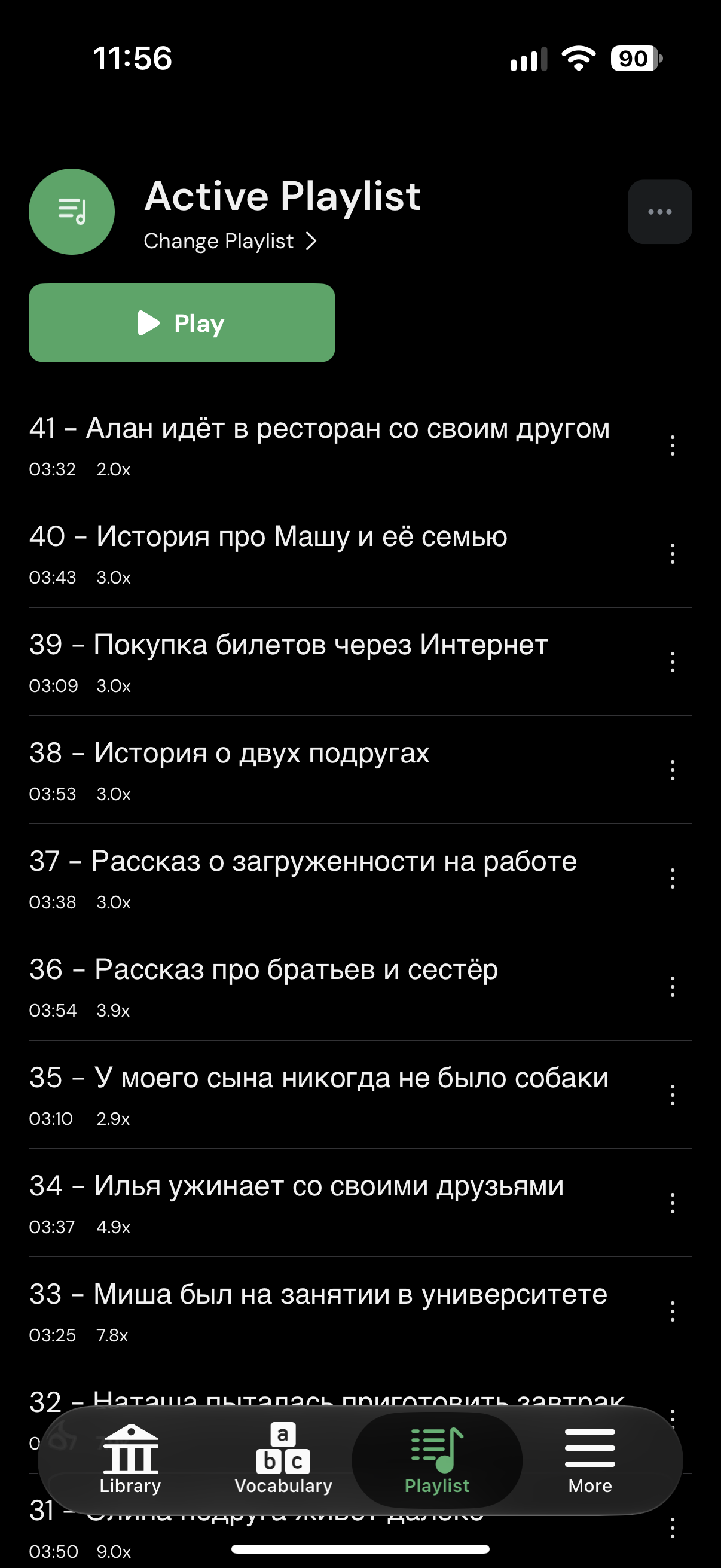
Why re-listen to stories I’ve already read instead of finding new audio? Because I already know the text, the audio is understandable instead of noise. Anki has drilled those exact sentences into my head, and listening is where I learn to recognize them by ear.
I pair this with a daily walk, outside if I can. I find that walking past the same scenery every day helps the previous days’ stories stick.
There’s a lot of repetition in this pipeline. It can feel boring at first, but about halfway through the Mini Stories there’s real variety. That’s also about when I noticed how much of the first story I understood, when it had been complete gibberish before.
Not understanding everything is normal
Reading, listening, and speaking are three separate skills, and each one has to be trained on its own. With this method, reading comes fastest, then listening, then speaking, so my listening is always behind my reading, and my speaking is always behind my listening. That’s expected.
What matters is listening consistently. I don’t need to be 100% focused, and there’s no right or wrong way to do it. If I keep listening, I gradually understand more.
“They talk too fast”
This is the most common complaint about listening, and the answer is to listen more. If you’ve only had 10 hours of exposure to how a language sounds, of course fast speech is hard. The more you listen, the better you understand it. Period.
Listening is much harder than reading, and consistency is the only thing I’ve found that makes fast speech understandable.
This video explains it really well with a Guitar Hero analogy. If you never move up from Medium because Hard looks too fast, you’ll never get to Expert. Hard feels impossible at first because your eyes and fingers haven’t seen those patterns yet, and the only way to get used to them is to keep playing at that speed. Fast speech works the same way. It only sounds too fast until you’ve heard enough of it, so keep listening to speech that feels slightly out of reach.
Tolerating ambiguity
Sometimes a word stands out while I’m listening. I half-recognize it, or I can tell it matters to the sentence, and I feel like I should know it. The urge is to stop and look it up. I don’t. I let it go and keep listening.
The next time that word comes around and I still can’t place it, the itch gets a little worse. By the time I finally meet it in Anki or LingQ, I’ve been annoyed at it for days, and those are the words that stick best for me. A word I look up the moment I hear it never gets that chance to build up. This is my experience, not a proven technique.
It’s part of a bigger skill: tolerating ambiguity. Studies find that learners who tolerate ambiguity do better at listening in a second language, because they go after the overall meaning instead of getting stuck on individual words.
I was bad at this when I started Romanian. Whenever I listened to something I couldn’t fully understand, I got frustrated. As I’ve progressed, I’ve made peace with it by focusing on what I do understand instead of what I don’t.
I think the real problem with listening is that it isn’t nearly as measurable. Anki hands me an artifact every day: I learned 30 new words. Listening gives me nothing like that. I’d guess I pick up just as many new things each time I listen, but none of it gets counted, so it’s easy to feel like nothing is happening. Knowing that makes it easier to keep going while I only catch half of what’s said.
After the Mini Stories
LingQ has more courses to choose from, and I pick whatever interests me most. As you move through the fluency levels, the content gets more relevant to you, and eventually more personal: you can read what you’re actually interested in instead of guided beginner material. I’ll write a separate post someday about what to do once you reach an intermediate level, but if you stick with this for 6 months, you’ll be blown away by how much you understand.